This technology uses genetically engineered yeast cells displaying fluorescent sensors to detect and recover rare earth elements from solutions, enabling rapid, specific, and scalable metal screening and extraction using fluorescence signals and high-throughput sorting.
Background
Rare earth elements (REEs) are a group of 17 chemically similar metals that are critical to a wide range of modern technologies, including electronics, renewable energy systems, electric vehicles, and advanced defense applications. The increasing global demand for REEs, coupled with their limited and geographically concentrated supply, has heightened the need for efficient, sustainable, and selective methods for their detection, separation, and recovery. Traditional mining and extraction processes are not only energy-intensive and costly but also pose significant environmental risks due to the use of harsh chemicals and the generation of toxic waste. As industries and governments seek to secure reliable REE supplies and reduce environmental impact, there is a pressing need for innovative solutions that can enable rapid, scalable, and environmentally friendly REE management.
Current approaches to REE detection and separation rely heavily on complex chemical processes, such as solvent extraction and ion exchange, which often lack specificity and require multiple, labor-intensive purification steps. These methods are not only inefficient for processing dilute or mixed-metal streams but also struggle to distinguish between chemically similar REEs, leading to low selectivity and high operational costs. Furthermore, the development of protein-based biosensors or bioadsorbents for REE applications has been hampered by the need for extensive protein purification, which is time-consuming and resource-intensive. High-throughput screening of REE-binding proteins is also limited by the lack of robust platforms that can directly evaluate binding and functional properties in a cellular context, slowing the pace of discovery and optimization. As a result, there remains a significant gap in the availability of scalable, selective, and cost-effective technologies for REE detection and recovery, especially from complex or low-concentration sources.
Technology Description
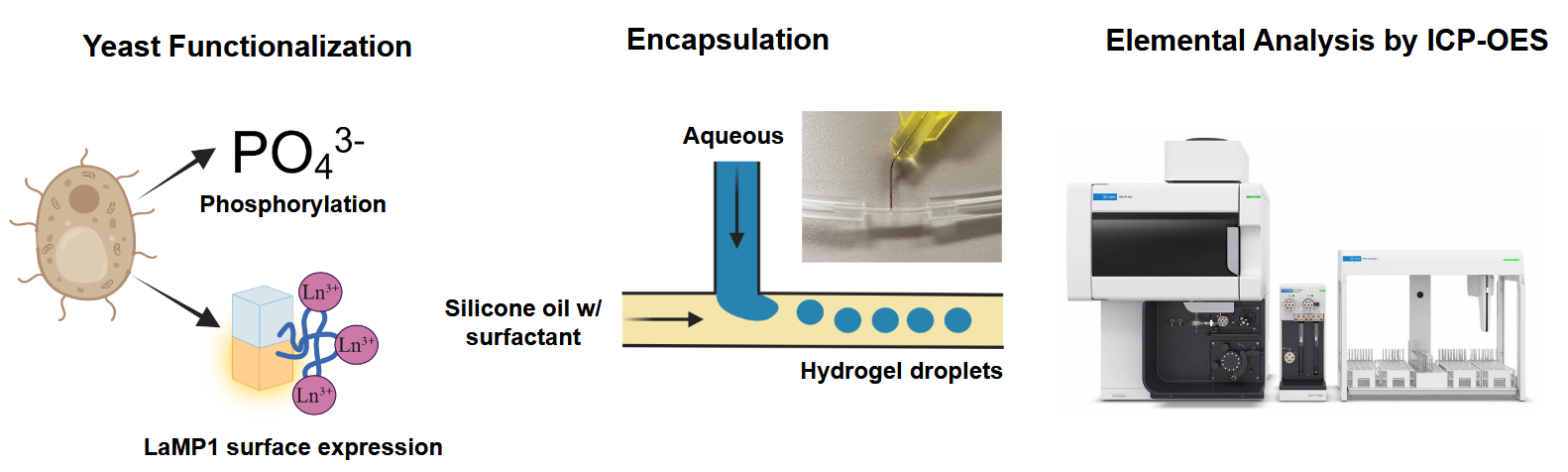
This technology is a modular biosensing and recovery platform for rare earth elements (REEs) that leverages genetically engineered host cells, primarily yeast, to display fluorescent REE sensors on their surface. The core sensor integrates a non-naturally occurring REE binding protein, such as lanmodulin or its engineered variants with specific mutations to enhance metal specificity and affinity, fused to a Förster Resonance Energy Transfer (FRET) donor-acceptor fluorescent protein pair. Upon binding REEs, the sensor undergoes a conformational change that alters the FRET signal, enabling ratiometric fluorescence-based detection directly on the cell surface. This system supports high-throughput screening using fluorescence-activated cell sorting (FACS) to rapidly evolve and select sensor variants with optimized binding properties. Additionally, the engineered yeast cells can be immobilized in acid-resistant hydrogels for scalable REE recovery from dilute or harsh industrial and environmental solutions.
The differentiation of this technology lies in its integration of advanced protein engineering, cell surface display, and fluorescence-based detection within a single, living platform. Unlike traditional REE purification methods that are costly, energy-intensive, and environmentally damaging, this approach eliminates the need for protein purification by evaluating sensor function directly on the cell surface. The use of robust host cells such as *Saccharomyces cerevisiae* allows operation under challenging conditions, while the modularity of the system enables rapid adaptation to target different REEs through directed evolution. High-throughput FACS screening accelerates the discovery of highly selective and cyclable binding proteins, and the ability to immobilize engineered cells in hydrogels supports practical, scalable deployment for REE extraction. This convergence of biosensing, screening, and recovery capabilities offers a cost-effective, sustainable, and highly customizable solution for critical materials management.
Benefits
- Enables sensitive and selective detection of rare earth elements (REEs) via ratiometric fluorescent signals.
- Allows high-throughput screening and directed evolution of REE-binding proteins using fluorescence-activated cell sorting (FACS).
- Eliminates the need for protein purification by displaying sensors directly on the surface of host cells like yeast.
- Supports scalable and robust REE recovery from dilute or harsh industrial solutions through immobilized engineered cells.
- Offers enhanced specificity and affinity for targeted REEs via engineered lanmodulin variants with rational mutations.
- Facilitates multiplexed detection of multiple REEs using different fluorescent reporters.
- Provides a cost-effective, rapid, and environmentally friendly alternative to traditional REE purification methods.
- Utilizes robust host cells tolerant to harsh conditions, improving operational stability in industrial applications.
Commercial Applications
- High-throughput REE biosensor screening
- Industrial REE wastewater recovery
- Multiplexed REE detection in recycling
- Mining effluent REE extraction
- Environmental REE contamination monitoring
Intellectual Property
PCT/US2025/035504
