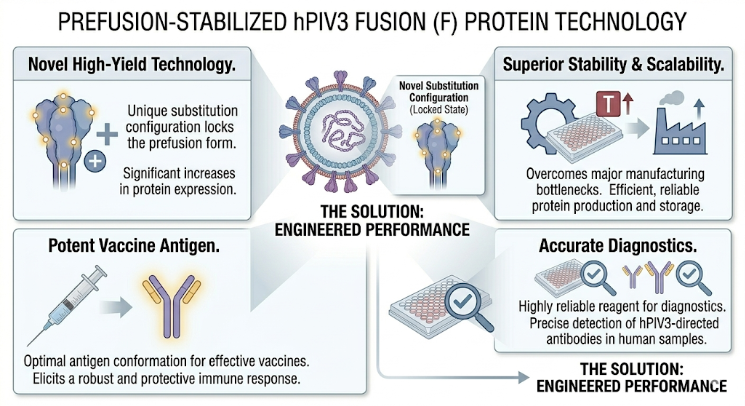
This technology uses novel amino acid substitutions to stabilize the human parainfluenza virus 3 fusion protein, enabling its use as a more effective vaccine antigen and diagnostic reagent by improving protein stability and expression.
Background
Human parainfluenza virus 3 (hPIV3) is a prevalent respiratory pathogen causing severe illness in vulnerable populations like infants and the immunocompromised. Despite its global health impact, no approved vaccines or specific therapeutics exist. Developing effective interventions relies on targeting the virus's fusion (F) protein, which mediates host cell entry. Eliciting a highly protective neutralizing immune response requires antibodies against this F protein in its native, prefusion conformation. Consequently, there is a critical need in virology to reliably produce these stabilized prefusion F protein structures for scalable vaccine manufacturing, accurate serological diagnostics, and effective vaccines.
The primary obstacle in utilizing the hPIV3 F protein is its inherent structural instability. The protein naturally transitions from its immunogenically optimal prefusion state into a post-fusion conformation, which fails to generate the necessary protective antibodies. While previous engineering attempts have sought to lock the protein in its prefusion state, current approaches suffer from poor structural stability and notoriously low cellular expression levels. This low yield creates major bottlenecks, making it unfeasible to produce antigens at the scale required for commercial vaccine distribution or reliable diagnostic assays.
Technology description
The McLellan lab has engineered prefusion-stabilized human parainfluenza virus 3 (hPIV3) fusion (F) proteins. By introducing specific amino acid substitutions, the technology locks the hPIV3 F protein into its prefusion conformation, which is the optimal state for eliciting a protective immune response. This stabilized protein offers the ability to develop highly potent vaccine formulations to protect against hPIV3 infections and precise diagnostic reagents for accurate detection of hPIV3-directed antibodies in human sera.
This technology is highly differentiated from existing approaches due to its unique set of amino acid substitutions. While previous stabilization attempts relied on different modifications, this novel configuration yields a substantial increase in both the structural stability and the overall expression levels of the F protein over prior stabilization approaches. By significantly improving these two critical metrics, this technology directly addresses major bottlenecks offering a superior, high-yield method for generating stable F proteins.
Benefits
Commercial Applications
