Graphene electronic tattoos are ultrathin, flexible, and transparent sensors that stick to skin like temporary tattoos to comfortably and accurately monitor vital signs, brain and muscle activity, hydration, and temperature for long-term, unobtrusive health tracking.
Background
Wearable physiological monitoring technologies have become increasingly important in healthcare, fitness, and research, enabling continuous, real-time assessment of vital signs and biometric data outside of clinical settings. Traditional approaches, such as gel-based electrodes and rigid wearable devices, have facilitated the measurement of signals like electrocardiograms (ECG), electroencephalograms (EEG), and skin hydration.
However, as the demand grows for long-term, ambulatory, and unobtrusive monitoring, there is a pressing need for sensors that are comfortable, conformal to the skin, and capable of delivering high-fidelity data without interfering with daily activities. The ideal solution would be imperceptible to the wearer, robust against motion and environmental factors, and suitable for applications ranging from medical diagnostics to human-machine interfaces.
Current wearable sensors face significant limitations that hinder their widespread adoption and effectiveness. Gel electrodes, while providing good signal quality, often cause skin irritation, degrade over time, and require frequent replacement due to drying out or loss of adhesion. Rigid or semi-flexible devices, including those using dry metal electrodes, struggle to maintain intimate contact with the skin, leading to high impedance, motion artifacts, and unreliable measurements, especially during prolonged use or physical activity. Many flexible sensors rely on adhesives or tapes that can be uncomfortable, visible, and unsuitable for sensitive skin or long-term wear. Furthermore, integrating ultrathin, stretchable sensors with conventional rigid electronics poses mechanical and electrical challenges, often resulting in fragile connections that fail under strain. These issues collectively limit the practicality, comfort, and accuracy of current wearable monitoring solutions, underscoring the need for new materials and designs that can overcome these barriers.
Technology description
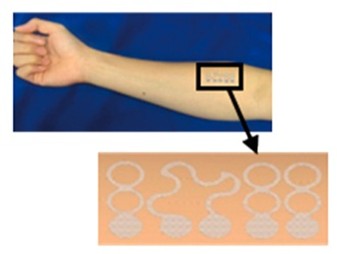
This technology centers on ultrathin, flexible, and transparent nanomaterial epidermal sensors known as graphene electronic tattoos (GETs). These sensors are fabricated by coating a monolayer of graphene onto a polymer substrate less than 500 nm thick, using a cost-effective "cut-and-paste" process that involves chemical vapor deposition, polymer support, and mechanical patterning. The resulting devices adhere directly to the skin via van der Waals forces, eliminating the need for adhesives or gels, and feature open-mesh, serpentine designs for high stretchability and breathability.
GETs are capable of capturing a wide range of physiological signals—including electrocardiograms, electroencephalograms, electromyograms, skin temperature, and hydration—with signal quality matching or surpassing conventional electrodes. The integration of Heterogeneous Serpentine Ribbons (HSPR) enables robust, strain-isolated connections between these sensors and rigid electronics, ensuring reliable performance during motion and long-term use.
What differentiates this technology is its unique combination of comfort, performance, and versatility. Unlike traditional wearable sensors, GETs are optically transparent, nearly imperceptible, and conform intimately to the skin, resulting in low contact impedance and minimal motion artifacts even during extended wear. The fabrication process is scalable, low-cost, and does not require cleanroom facilities, making it accessible for widespread adoption.
The HSPR interconnection strategy further enhances durability by reducing strain on the sensor-electronics interface, allowing the system to withstand significant deformation without signal loss. GETs also support multimodal sensing—including cuffless blood pressure monitoring using machine learning algorithms—demonstrating accuracy that meets or exceeds clinical standards. This comprehensive platform, protected by patents and validated in peer-reviewed studies, represents a transformative advance in unobtrusive, high-fidelity wearable biosensing for healthcare, research, and human-machine interfaces.
Benefits
- Ultrathin, flexible, and transparent design enables comfortable, imperceptible, and long-term skin wear without adhesives.
- High-fidelity electrophysiological signal monitoring (ECG, EEG, EMG, EOG) with superior signal-to-noise ratios compared to conventional electrodes.
- Multimodal sensing capabilities including skin temperature, hydration, electrodermal activity, and cuffless blood pressure monitoring with clinical-grade accuracy.
- Robust mechanical performance with high stretchability (up to 40-50%) and durability under repeated skin deformation and daily activities.
- Low skin contact impedance due to intimate conformability, reducing motion artifacts and environmental interference.
- Cost-efficient, scalable fabrication using a "cut-and-paste" method without complex cleanroom processes.
- Innovative heterogeneous serpentine ribbon (HSPR) interconnection ensures reliable integration with rigid electronics and strain isolation.
- Generalizable platform technology applicable to other ultrathin, skin-conformable electronic sensors for healthcare and human-machine interfaces.
Commercial applications
- Continuous ambulatory vital signs monitoring
- Long-term wearable ECG/EEG/EMG sensors
- Cuffless blood pressure monitoring
- Real-time hydration and temperature tracking
- Human-machine interface for prosthetics
Additional information
These ultrathin, flexible epidermal sensors utilize patterned graphene on a polymer substrate. Adhering to skin via van der Waals forces, they precisely measure electrophysiological signals (ECG, EEG, EMG), skin temperature, hydration, and enable cuffless blood pressure monitoring. Their design allows comfortable, high-fidelity, long-term biometric data acquisition.
Intellectual property
U.S. 11,786,170
