Background
The development of high-energy-density lithium-ion batteries (LIBs) is crucial to meet the growing demand for electric vehicles and portable electronics. Silicon (Si)-based anodes have emerged as promising candidates due to their high theoretical capacity and abundance. However, the practical application of Si-based anodes, particularly when paired with high-nickel layered oxide cathodes, is hindered by significant challenges. Si-based anodes suffer from severe structural and interfacial degradation during cycling. The large volume expansion of Si upon lithiation leads to particle pulverization, continuous solid-electrolyte interphase (SEI) breakdown and reformation, and loss of electrical contact. This degradation is exacerbated by transition-metal crossover from the high-nickel cathode, which catalyzes detrimental side reactions at the anode-electrolyte interface, accelerating capacity fade and shortening battery lifespan. Conventional approaches, such as modifying binder mechanical properties, have proven insufficient in addressing these critical issues.
Technology Description
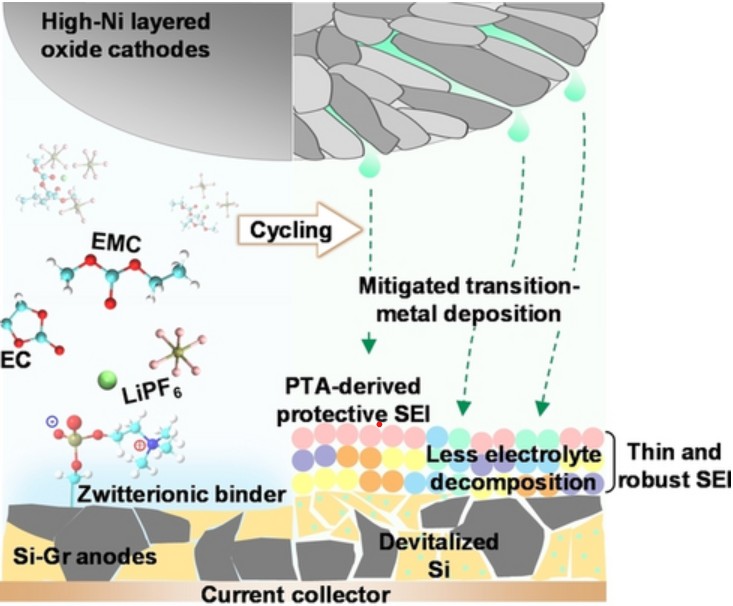
This technology involves a novel zwitterionic binder for silicon-based anodes in lithium-ion batteries, specifically designed for use with high-nickel layered oxide cathodes. This binder addresses the structural and interphase degradation issues common in silicon anodes, particularly those exacerbated by transition-metal crossover from the cathode. Synthesized by grafting and polymerizing zwitterions onto polysaccharides, the binder creates a unique electrically charged microenvironment at the anode-electrolyte interface. This results in a more stable, robust, and uniform solid-electrolyte interphase (SEI) that effectively resists transition-metal deposition and minimizes electrolyte decomposition.
What differentiates this technology is its ability to directly manipulate the SEI formation process through its zwitterionic nature. Unlike conventional binders that primarily focus on mechanical properties, this binder actively regulates the chemical composition and spatial distribution of the SEI. This leads to a thinner, more uniform SEI rich in protective components, enhancing the anode's longevity and performance. Furthermore, the binder's ability to mitigate transition-metal deposition within the silicon anode directly addresses a critical degradation pathway in high-energy-density batteries, making it a significant advancement in battery technology.
Benefits
Commercial Applications
Patent
PCT/US2025/036440 filed in July 2025
Publication
https://onlinelibrary.wiley.com/doi/10.1002/anie.202408021
