Background:
The rising levels of atmospheric carbon dioxide (CO2) present a critical global challenge, significantly contributing to climate change and ocean acidification. Current CO2 sequestration methods, such as geological storage, face numerous hurdles, including leakage risks, high costs, and the need for extensive monitoring. An emerging method involves the formation, compaction, sealing, and disposal of CO2 hydrates on the seabed. CO2 hydrates are solid, ice-like structures that form under high-pressure, low-temperature conditions unique to the ocean floor. This method offers several advantages over traditional storage techniques, including increased stability, reduced risk of leakage, and the potential for long-term, large-scale CO2 storage. However, the artificial synthesis of CO2 hydrates is slow, hindered the development of hydrate-based industrial technologies. The fastest reported CO2 hydrate formation rate is 20 g/L/hr, insufficient for large-scale carbon sequestration. Therefore it is crucial to promote faster hydrate growth in order to achieve gigascale CO2 sequestration through hydrate formation.
Technology Overview:
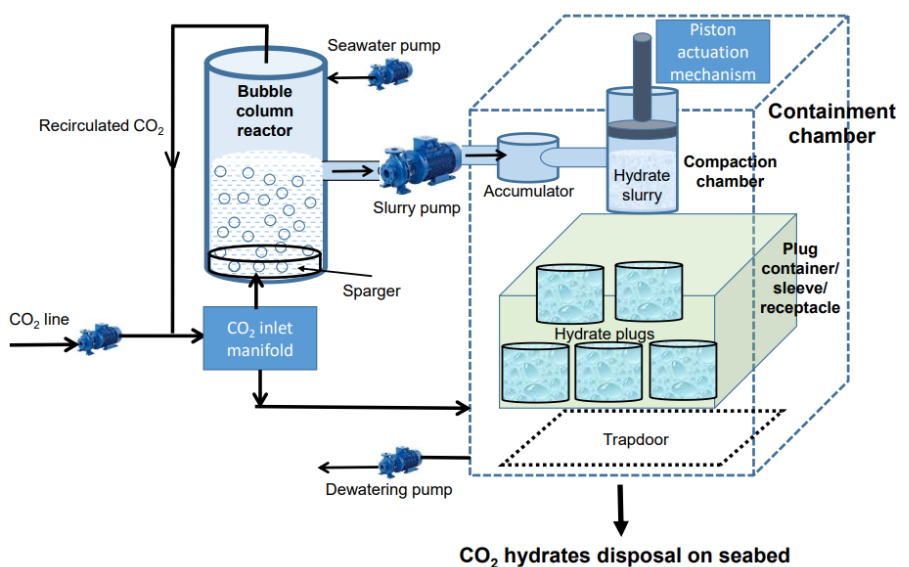
This technology provides a comprehensive solution for the formation, compaction, sealing, and disposal of CO2 hydrates on the seabed, addressing the major challenge of slow hydrate formation. The process begins with the rapid formation of CO2 hydrates in a bubble column reactor, where CO2 is recirculated to enhance the formation rate. This approach significantly accelerates hydrate formation (800 g/L/hr), overcoming the limitations of traditional methods. Once formed, the CO2 hydrates are compacted into dense plugs, ensuring stability and ease of handling. These plugs are then sealed to prevent dissociation and leakage during transport. The sealed CO2 hydrate plugs are transported to the seabed, leveraging natural oceanic conditions to maintain their stability. Finally, the plugs are disposed of on the seabed, where the high-pressure, low-temperature environment ensures their long-term stability and prevents CO2 from escaping back into the atmosphere. This method offers a scalable and efficient approach to CO2 sequestration, providing a viable solution for reducing atmospheric CO2 levels and mitigating the impacts of climate change.
Benefits
Applications
Opportunity
